|
|
|
|
|
|
|
|
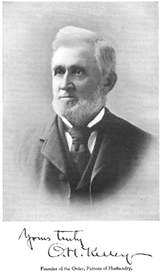
| Oliver Hudson Kellley |
|
Below is a remarkable history of the National Grange written personally by the father of the Grange, Oliver Hudson Kelley. The article was written at the request of the Connecticut State Grange in 1900 as it was compiling a thorough history of the Grange in the state up to the turn of the century.
THE CONNECTICUT GRANGES - ORIGIN OF THE ORDER |
By O. H. KELLEY
Your request for a brief sketch touching the early history of the Order of the Patrons of Husbandry, and particularly the circumstances leading to its inception, carries me back many years and recalls so much of interest it is with difficulty that I select the materials to suit your purpose.
It should be bourne in mind that the historian of events in which he has been the principal actor must necessarily say much of himself, and this, of itself, to one of my “innate modesty,” is a task of large proportions. Age, however, and extensive contact with public men generally have worn off the keen edge of my sensitiveness, and so I set about my business in the spirit of self-sacrifice and self-immolation upon the altar of duty, much as our modern Senators accept a re-election at the hands of a clamoring legislature which knows its business. |
|
|
When and under what circumstances was the idea of the Order first conceived? What was the chief incident that led to its birth?
With one exception (ex-Senator Ramsey of Minnesota) all the parties then interested, except, of course, the writer, who still entertains the motion that he is alive and kicking, have long since joined the “great majority”; and so I am at liberty to write about matters that have never before been mentioned in print. At the time of their happening, I considered my trials and tribulations a fair match for the torments of the last lamented Job, who, you will recall, was the Scriptural gentleman with boils; but now, after thirty-four years, I can laugh heartily as I recall them.
In the fall of 1864, I came to Washington, under the wing, so to speak, of Senator Ramsey of Minnesota, as the Washington correspondent of the St. Paul Pioneer, then edited by Louis E. Fisher. To help pay my expenses for enlightening the great Northwest as to the doings of the salons at the Capital City – for in those days the boys of the press hadn’t made much headway with the God of Mammon – I received an appointment as a first-class clerk in the Department of Agriculture at a salary of one hundred dollars a month.
The Department of Agriculture had just been established, and Hon. Isaac Newton, a good old Quaker, appointed Commissioner. James H. Grinnell, of Massachusetts, was the Chief Clerk, and William Saunders, afterwards Master of the National Grange, was the Superintendent of the Experimental Garden. I mention the names of these gentlemen because it was their abilities solely that gave any semblance of character to the new institution at that time. To me it seemed to be branch of the Government where Senators and Congressmen unloaded the mighty host of their importunate office-seeking constituents, whose sole duty after appointment was believed to require their prompt attendance on pay-day, a duty for the neglect of which a reprimand was seldom known to be necessary. It goes without saying that I was never the subject for such a reprimand.
Notwithstanding its defects, it was the nucleus for what is now one of the largest and most important of the Executive Departments of our humane but ever expanding government.
The Commissioner was an eccentric old gentleman, who, next to himself, loved his maker and flattery; and his office and its administration often formed the basis for Senatorial jokes. Still he was always ready to listen to suggestions, even if he did not heed them; and he like to be consulted even in matters beyond his jurisdiction, if they affected his Department. Doubtless for this reason he requested, and I always submitted to him, the manuscript of my correspondence with my paper; and I new enough of his peculiarities always to win his approval.
During the summer of 1865, while I was in Minnesota on leave of absence, I conceived the idea of taking a southern trip and writing up the agricultural and mineral resources of the fruitful Southland; and, as the Commissioner was in a position to make this possible for me in a very pleasant way known to the initiated at Washington, I wrote to him concerning it, with the endorsement of Senator Ramsey. This brought me the following letter:
Department of Agriculture
Washington, D.C., October 20, 1865
O. H. Kelley, Esq., Itasca, Minn.
Dear Sir:
I am exceedingly anxious to have you come to this city by the 1st proximo, if you can possibly arrange to be here by that time. I wish to see you on special business requiring your presence.
I am, Sir, Your obedient servant,
Isaac Newton,
Commissioner.
Of course this special business could be nothing other than that connected with my Southern trip, and so, on reaching Washington, I immediately called upon Mr. Newton, as he requested. Judge my surprise when he informed me that he had lately bought a gold mine in Northern Alabama, and he wanted me to go down and look it up. I suggested that it would hardly do to make that my special business, and at the expense of the Department, too, but if I had an appointment to report upon the agricultural and mineral resources of the South, I could take in the gold mine and give it special attention, if needs be. This proposition met with his approval, and he told me to hold myself in readiness to start on short notice. I did manage to hold myself for six weeks, before proceeding to stir him up. He told me he had reconsidered his original intention, and that he was not going to give me the appointment; and I went back at him with a breezy Western rejoinder that I was determined he should, which brought from him an inquiry as to whether he or I was running the Department. We parted, however, without bloodshed and, at this point, the State of Connecticut became interested in my plans, and the outcome of its interest was the birth of the Order of the Patrons of Husbandry. |
 |
|
President
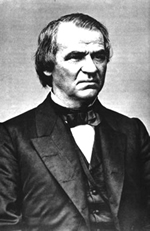
Andrew Johnson |
|
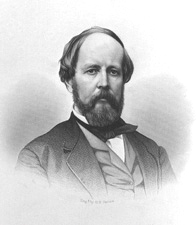
At this time, the Senate had divided in sentiment towards the President, Johnson, and Senator Dixon, then Senator from Connecticut, had become a prime favorite with the President. It was my good fortune to be a frequent visitor at his house. I gave him a full account of my plans and of my difficulty with the Commissioner of Agriculture, and told him that I was anxious to interest the President in my scheme. The Senator entered cheerfully into the matter, and during the first week in January 1866, secured me an interview with the President for the following Wednesday morning at ten o’clock.
The virtue of promptness which I had so successfully cultivated on paydays at the Department of Agriculture enabled me to be on hand at the proper time, and I was rewarded with a very pleasant interview with President Johnson.
I explained my plans fully and he heartily approved them, saying that as soon as the people of the North and South unite their capital and energy and develop the vast resources of the Southern States they will challenge the admiration (and he might also have added the envy) of the world. |
|
I discovered at this interview that the Commissioner was not considered a very difficult obstacle to the onward march of progress at the White House; and just as we were about to depart, the President requested the Senator, on his way to the Capitol, “to drop into the old man’s office and tell him to come up here, I want to see him.”
On the way to the Department I suggested to the Senator that he had better see Mr. Newton privately about the matter, but he insisted that it “would be a good joke on the old man for us to break the news to him together,” which we did.
You don’t have to live long in Washington to appreciate the value of a Senator for backing when you have to interview the head of any of the Executive Departments. Our reception this time was more genial; the message was delivered; and when the Senator left me he told me in the corridor that the coast was now clear and I might arrange the rest to my own liking.
After about two hours time, the confidential clerk of the Commissioner came to my room and asked in a humorous manner, “What instructions have you to give the Commissioner, Mr. Kelley?” Just as humorously, I handed him the form of the appointment or commission which I had previously prepared, and my southern trip became possible – a trip the results of which suggested the idea of the Grange.
Through Senator Dixon’s influence, I had not only won my fight, but everything had been amicably arranged with the Commissioner to my entire satisfaction, and before I left the Department that afternoon he had warmly congratulated me upon having the favor of the President. |
 |
|
Senator James Dixon who served as a Senator from CT from 1857-1869. |
|
Through Senators Ramsey and Dixon I received letters of introduction to Governors of several of the Southern States; a government pass over all the mail routes, the contribution of the Postmaster-General, to which were attached certain private instructions; and when I was ready to start, on the 13th of January, I found myself well provided with the munitions of peace and full liberty to go where I like to use them and make the most of my opportunities.
One of my good friends advised me, before going South, to take a couple of revolvers, plenty of ammunition, and a body-guard, as I would find some fellows “down there” who would not be likely to take kindly to a Boston Yankee; but knowing my weakness as a marksman, and being heartily – even so far back as that – in accord with the beautiful tenets of the American Peace Society, I concluded that good behavior, self-respect, a little cheek, and a well-sharpened lead pencil, with a bountiful supply of paper, would win me an audience in the Southland and as cordial a reception as I could wish. |
|
Through my letters of introduction and the gentlemen to whom they were addressed, I made many acquaintances with prominent planters; and it is a singular fact that about nineteen of every twenty of them belonged to the Masonic fraternity.
We could talk all day and night upon agriculture, but political questions were not to be thought of. As a result of these talks and observations of the feelings and character of the southern people, I concluded great good would result from bringing the farmers of the country together in a fraternity that would bind them as closely as the Masonic fraternity binds its bands of brothers, a fraternity which would have for its object the mutual benefit and interests of the men who till the soil, the bone and sinew of this great Republic. It was plainly to be seen that the wrangling and quarreling of politicians in Congress were not going to restore harmony in the south. Might not my idea of a farmer’s fraternity accomplish more?
That idea and its outcome have been vindicated before the people of this country, and I doubt not in the eyes of the world. The results are well known, and it is not my purpose to discuss them here; but great and small, they were all the children and the grandchildren of that southern trip, which my good friend, the first Commissioner of Agriculture, had so nearly killed while it was “a-bornin’.”
I found Newton’s gold-mine friend at a prominent town in Georgia, presented my letter of introduction to him, and solicited all the information possible concerning the “diggings.” My impression from my first interview was that there was more natural gas than gold in the scheme; but I took a detailed description of the property, which was said to be located in the mountains north of Selma, Alabama, and made my way to that point to continue my investigation. When I reached Selma and made known my intention of searching for the gold mine, I was advised that I would find it “skeery business” if I tackled the “highlands,” as the “Moonshiners” might mistake me for a revenue officer and fill me with lead. I was not searching for that kind of mineral, or at least in the way in which I was likely to find it, if my curiosity led me into this forbidden territory, and being satisfied by reliable parties that there had been some “pockets” of gold found prior to the war, I confined my further efforts to purchasing a few nuggets from a jeweler to prove that gold existed where these samples were said to have been found; after which my eyes were turned to headquarters.
On my trip I kept a daily journal, and noted down each night the results of the day’s observations, thus accumulating a vast deal of information of every variety; and in addition I made invaluable reports weekly, for the benefit of the government archives, to the Commissioner of Agriculture.
I returned to Washington April 21, and later went to Boston, where I met Miss Hall, my niece, to whom I gave the first crude outline of my idea of the organization of the fraternity which we all now know as the Patrons of Husbandry. The suggestion to give woman full membership in it was hers. As we are both natives of Boston, we may well claim that the order, through the aid of [Conn.] Senator Dixon, is of New England origin.
Returning afterwards to my farm in Minnesota, I made no decided move in the work until May, 1867, and it was a year after that before matters were in a shape to warrant my starting out on my tour to introduce my idea to the farmers of the United States. Then came more trials and tribulations; but after four years of the hardest kind of work I found success. In my History of the Order, published in 1875, will be found a compilation of letters, touching the early history of the movement which were carefully saved, the authors of which were innocently writing the history of the institution as it progressed.
Among those to whom we are largely indebted for aid is the Hon. Thomas B. Bryan of Chicago; who always cheerfully furnished funds when the Exchequer was low; and in February, 1871, he saved the National Grange from a final collapse with a loan, which, however, was repaid a year later, and which amounted to but one hundred and eighty-four dollars. But from the date of that loan to the present time, the National Grange has always been able to pay its own way on a cash basis, and the day of its bankruptcy is as far off as the Day of Judgment. |
It is a pleasure to say also that the Farmers Loan and Trust Company of New York has, since the Georgetown session of the National Grange, been the Financial Agent of the Order. Brother F.M. McDowell, was the Treasurer while living, and the post has been most ably and conscientiously filled by his wife, who was elected to the office at his death. These are most important matters to remember, for the stability of the treasury is the life of every successful institution.
That the order, in its early days, from 1872 to 1875 inclusive, did a great work was shown by its rapid growth in the southern states, every one of which was ably represented at the annual sessions of the National Grange, and, if memory serves me correctly, every State and Territory, excepting Rhode Island, was represented at each of the three consecutive sessions.
While the two great political parties were excited to fever heat and each of them lashing its adherents, as far as possible, into a fury of passion and almost hatred, while even our good friends of the Presbyterian and Methodist churches, North and South, continued their war- indeed, |
 |
|
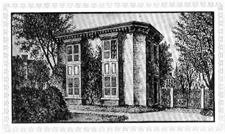
Office of William Saunders, the Superintendent of the Propagating Gardens in Washington, D.C. where he worked with Oliver H. Kelley and the five other founders to establish the Patrons of Husbandry. The building was located where the National Mall is now located. It no longer stands but a plaque recognizing the importance of the site was placed there by the National Grange. It is the only private memorial of its type to be allowed on the National Mall. |
|
|
I am not aware that they have yet ratified their Treaty of Peace – the northern farmers and the southern planters were meeting together in the bonds of fraternity, and brotherly love and friendship lasting as life and pleasant as Heaven were cementing the hearts and interests of the Patrons of Husbandry.
History shows that it takes political parties and religious organizations to wage bloody warfare and perpetuate hatred; and this was never shown with greater clearness than just subsequent to the close of our great Civil War; but while the rest were continuing their strife, the subordinate Granges north and south were having their feast of harmony every month in the year, forgetful of the wrangling of the churches and demagogues around them; and yet these very Granges numbered among their members many who could not fraternize with their dissenting brethren outside the Grange Halls, except upon matters connected with the Order which was dear to them both.
It was the Grange with offered the first olive branch of peace to north and south, and that it was successful in uniting elements as opposite in their natures as oil and water, speaks well for the grand principles upon which it was founded.
It is these principles which are the main security of the Order, as the subordinate Granges, with their large and sturdy membership, such as is now found in the New England and Middle States, are the bone and sinew of this modern giant.
The falling off in membership and activity in southern and western states is due chiefly to local causes; but I have little doubt that a revival of interest will come and with it a growth in the membership which will lastingly insure to the Order its position as the oldest and nearest to perfect organization of farmers in the United States, and, indeed, in the world.
Thirty years of vast and unremitting labor, and thousands of active, brilliant minds have been the means of placing the Order where it is to-day, and, as science tells us that nothing is lost of force or matter in this mighty world of ours, I am sanguine enough to believe that this product of stupendous labor and the ablest intelligence of the land will not only live, but go on and on in its work of progress and civilization first and foremost in the ranks of honorable organizations which have made and will continue to make this world of ours brighter and better and fit it for the approving voice of the great Master in the Grange beyond. |
|
|
| |
|
|
|
|
|